Tuesday, February 25, 2014

Foggy Day


Foggy Day

Some ground was finally beginning to show through the snow on Friday after being blanketed in white for days. But then irony took over. The ground was visible but the sky was not. Heavy fog was everywhere.

We could hear birds chirping but they didn’t seem to be flying anywhere. Birds can fly in fog but prefer not to as they can become disoriented. These geese landed within the confines of a local school, the flock choosing to hunker down and take a rest until the fog lifted.

Birds are not the only ones who can get disoriented; people, too, find fog confusing. Going across the Ben Franklin Bridge to Philadelphia was an experience in caution. Where was the car ahead of us? Where were the lanes? It was hard to think we still on the bridge because we couldn’t see the cables. 

It was beautiful, in its own, soft way. All things blended. There were no hard lines to anything. The road, the buildings along the way, the people on the streets, all were fairy-like. I wouldn’t have been surprised to see someone sprout wings and take off into the clouds. Sometimes it’s nice to have that sense of fantasy to gentle a day, especially after a snow-shoveling marathon.
 
What causes fog?

Be safe when driving in fog:
http://www.weather.com/activities/driving/drivingsafety/drivingsafetytips/fog.html

Monday, February 17, 2014

Hidden and Revealed


Hidden and Revealed

I was driving down a neighboring street the other day and saw a couple of trees that made me stop the car and pull over to contemplate them. There were no leaves on their branches (rightfully so in this season) and it was too early for them to flower but there was a sense of life about them from nests that spoke of birds and eggs and life cycles that usually are hidden from ordinary sight. Such private things, now revealed. It felt like I was peeking at something sacred.

I didn’t know which birds had built them, if it was one species or a mixture; we have many different birds calling our area home. We have squirrels that make nests in our backyard maple and white pine trees, though these nests didn’t seem large enough for them. Will the birds come back to the same nests in Spring or will these start to fall apart, offering their twigs for new nests and new life?

So much of life is hidden; flowers within buds, plants concealed in seeds, babies inside bodies. Eventually the impetus of nature reveals them and the world gets to see the beauty that was harbored there. An idea is hidden until someone speaks it or acts upon it and allows others to see it. This duality has an energy that speaks of movement, of progression, of growth. In it, like with the change of seasons, is a sense of anticipation that animates life.

When we come upon something that we hadn’t seen before or understood or perhaps even considered, it opens us to a broader dimension of existence. It helps us to stop in our everyday tracks and pay attention. And it may even bring a feeling of gratitude for having been there at the right moment to discover something more of ourselves.

Which birds reuse their nests? Join the conversation:
http://www.thriftyfun.com/tf97112338.tip.html

Monday, February 10, 2014

Keeping Warm in Winter


Keeping Warm in Winter

How can a body keep warm on these frigid days? Birds fluff up their feathers. Rabbits puff up their fur. Squirrels, besides running around like crazy, find inventive ways to garner heat. This one found a bit of warmth atop our woodpile. He spread himself (herself?) over the dark-colored bark in the mid-afternoon sun when it would be the warmest. Whatever works…

Staying warm has been a challenge for people, too, this winter. I stuff myself into layers of clothing before venturing out the door. I wear mittens instead of gloves to keep the heat of my hands concentrated. Even indoors, a fleece is my friend.

There have been lots of communities, which translates into hundreds of thousands of people, that have been stranded without heat at various times this season, due to iced power lines. Ice increases the weight on the lines, which can cause them to break. It also strains tree branches that then can snap off onto power lines. This year Pennsylvania was hit particularly hard by ice storms and some households still do not have power.

So, how does one keep warm during freezing times?  Here are a few suggestions that might help.

How to keep warm outside:

How to keep your house warm:

How to survive a power shortage:
http://www.accuweather.com/en/weather-news/how-to-survive-an-ice-storm-po/20680035

Monday, February 3, 2014

Cardinal on the Edge


Cardinal on the Edge

Guess what? It’s snowing here, again. It was warm yesterday and a good deal of the prior snow had melted. I could actually see grass in the yard and buds on the trees. Just when I put the snow shovel away, I have to drag it back out.

I wonder how confused the outdoor creatures must be. I can almost here the squirrels saying, “Snow again? Didn’t it snow already this winter? What is going on?” 

The birds, too, might be getting fed up with the weather. Snow covers the birdbath, blows into the feeders, coats the tree branches. It’s almost nesting season but who wants to build a nest just to have it soaked when the snow melts? 

I tuck myself into a warm coat just to get to my car. I can see the animals puffed out against the flakes and the wind. The birds fluff their feathers for whatever protection that provides.

And yet, it isn’t snowing everywhere. In one town over it is only raining. It seems weird that weather systems have edges. These are known as weather fronts. It is the boundary between two air masses. One side can be dry and cold while the other moist and warm.

But it really shouldn’t be a surprise. Doesn’t everything have an edge? How would we distinguish one thing from another if it all blended together? People are individuals. So are all living things. The boundary needn’t be abrasive, however. I’m thinking about countries that are reluctant to let each other live in peace, religions that stigmatize anyone who doesn’t follow the dogma, or politicians who discredit any idea that doesn’t echo their own. Perhaps if we see boundaries as places to connect rather than divide, we will be able to appreciate that edge – even if it means more snow. And aren’t snowflakes beautiful?

Check out the weather predictions for your area:

And if you are a history buff, here are historical weather records:

Tuesday, January 28, 2014

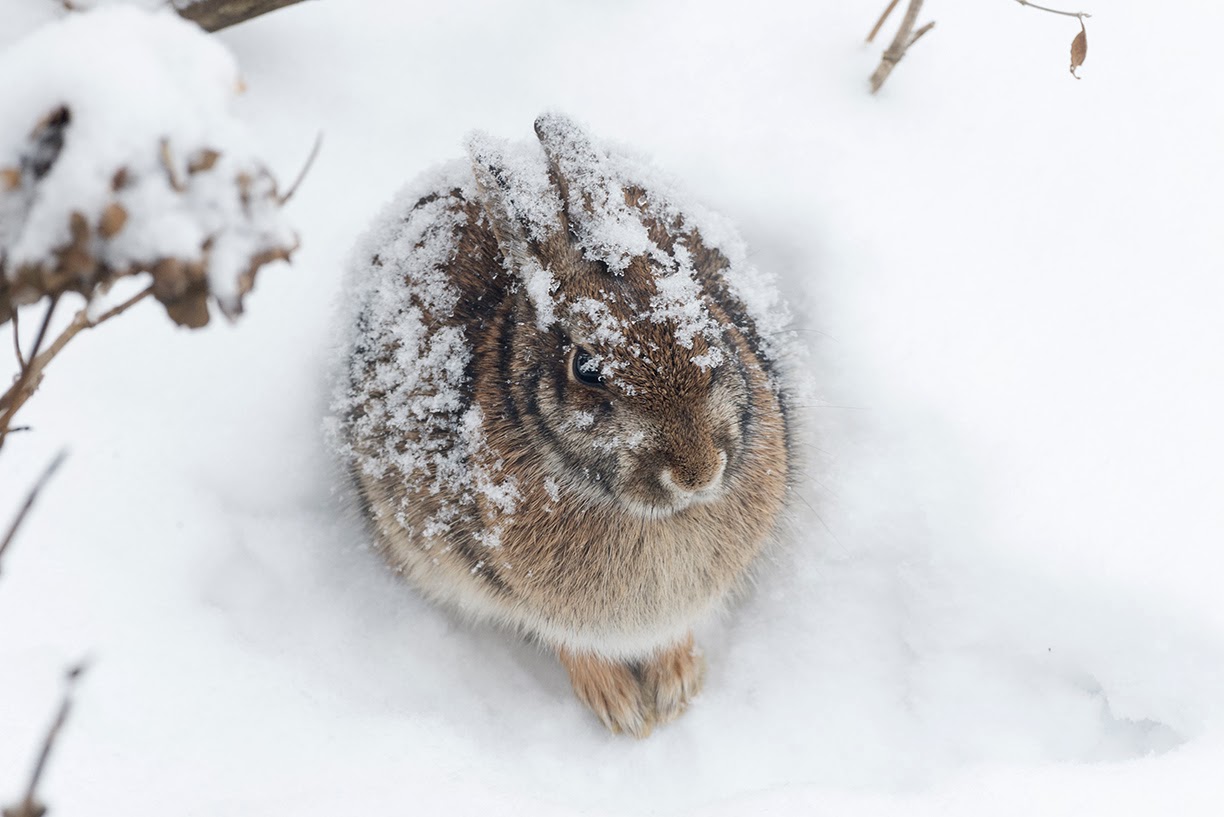
Rabbit in the Snow


Rabbit in the Snow

I was gazing out the window, looking under the butterfly bushes at the juncos scrambling for seed when I saw what looked like a piece of a log slowly being covered with snowflakes. But it wasn’t a log at all – it was a rabbit! It was resting in a depression atop last week's snow. Its fur was puffed up like a down blanket, protection against the cold. 

Rabbits do not hibernate in the winter. I have seen several cottontails bounding through my yard all season even when the temperature has been cold enough to keep me inside.

I thought it might like a carrot, given that snow had been covering the ground for the better part of a week and no doubt interfered with the animal’s foraging. I didn’t want to throw it out the window and scare the rabbit away so when I saw it had moved away, I tossed out a nice, juicy organic carrot and hoped it would come back and find the treat. It didn’t – return or eat the carrot.

What I found out was that rabbits change their dietary needs in the cold weather, from vegetables (yes, gardens are a prime venue for these creatures in the spring and summer) to buds, seeds, twigs, branches, and pine needles. We have all of those in our backyard so I guess the rabbit felt welcome but didn’t need the carrot.

BTW Did you ever wonder why rabbits are often called bunnies? Bun is an old English word for “little tail.” More often a baby rabbit is referred to as a bunny, a more endearing term for a small, let’s face it, adorable animal.

But rabbits, cute as they are, are still wild and should be respected as such. We can live together and appreciate each other. All creatures have their place, habits, preferences, and way of life and can be valued for the diversity we all bring to the earth - even as we protect our gardens from the bunnies.

Literally, anything you might ask about rabbits is answered here:

Tuesday, January 21, 2014

Boat Dreams Come With Responsibility


Boat Dreams Come With Responsibility

Winter is confused this year, with temperatures bouncing from the mid-sixties to minus degrees. We have come to expect some variation but this season has been extreme and we’re not even halfway through. The confusion is justified. The seasons are determined by the earth’s rotational axis as it travels around the sun in an elliptical path. Each season has its own character in regard to precipitation, temperature, wind, the amount of daylight. All of this affects our activities.

But our seasons are experiencing change because our climate is changing. New patterns of drought, flooding, cold, and heat are affecting our earth, which in turn affects us all. We have experienced stronger storms in the past few years, with unanticipated outcomes. Our crops are dependent on stable local climates; too much variation can lead to crop failure. There are things we can do to slow it down, if we have the will. http://www.epa.gov/climatechange/wycd/ 

Perhaps we can call up the will through our memories and daydreams. This boat, sitting swaddled by the bare trees, hints at warmer days, beach weather, fishing, and adventures on the water. The garden catalogues that arrive in the mail speak to us of new growth, of vibrant spring colors and gardens filled with ripening vegetables waiting for the right time to be picked.

And while we’re daydreaming, let’s remember to appreciate the season we’re in. Let’s enjoy that welcoming cup of hot chocolate or jasmine tea as we come in from the cold. Let’s savor the beauty of the snow when it drizzles down from the sky – shoveling comes later. And let’s allow ourselves to luxuriate in the embrace of our dreams.  But let us not forget that our daydreams come with responsibility. There is work to be done if we want to help the earth be the kind of place we remember and cherish.

Characteristics of the seasons:

The science behind the seasons:

How does climate change?:


Tuesday, January 7, 2014

Brrr - It's Cold Outside


Brrr - It’s Cold Outside

Wow, the temperature is going crazy lately. Two days ago it snowed where I live. Yesterday started out at 60 degrees, confusing winter with spring. It didn’t stay there, however; the thermometer reading dropped down precipitously throughout the day. By this morning it was 5 degrees, with a wind chill making it feel like minus in the teens. Going out took determination, not to mention a hat, gloves, scarf, sweater, and heavy winter coat.

There is a natural material that is expert at warmth from which many of these products are made - wool. It wicks outside moisture that might chill us away from our body. It also soaks up sweat that we produce to cool us off, a benefit in the hot weather but not good in these kinds of temperatures, and traps it so that we don’t lose valuable body heat. It is also breathable, which makes it adapt to a variety of conditions.

Where does wool come from? Animals. Sheep, alpacas, goats and rabbits are all good sources of wool. It keeps the animals warm in the harshest of weather and it works for us, too. And the good thing is that no animal need be harmed by harvesting the wool. There are grades of wool, too, from the finest to the thickest, each type good for its specific uses.

So, when you are thinking of going outside in these single-digit days, think wool. And also consider layering, a simple technique that helps keep us warm. And enjoy these beautiful days, whatever the temperature.

The definitive word on wool:
http://www.sierratradingpost.com/lp2/wool-guide/