Showing posts with label bunnies. Show all posts

Tuesday, January 28, 2014

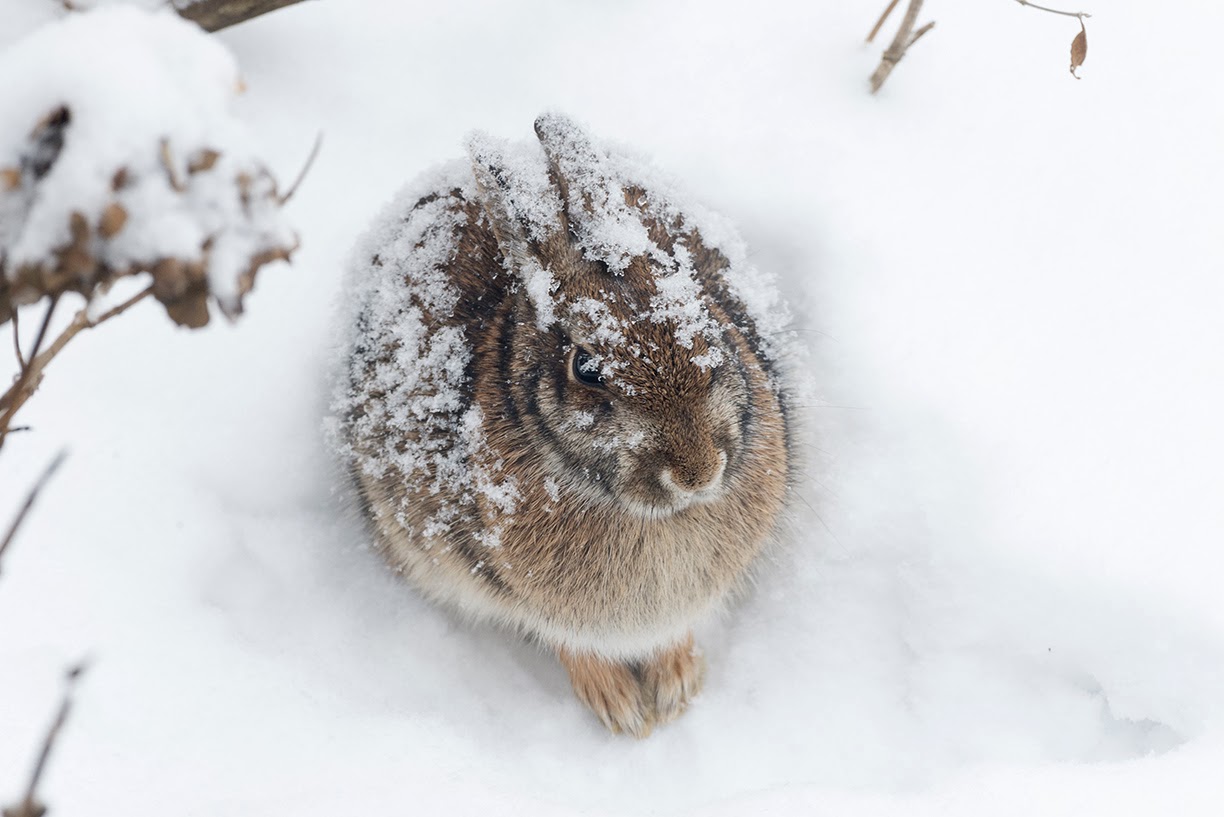
Rabbit in the Snow


Rabbit in the Snow

I was gazing out the window, looking under the butterfly bushes at the juncos scrambling for seed when I saw what looked like a piece of a log slowly being covered with snowflakes. But it wasn’t a log at all – it was a rabbit! It was resting in a depression atop last week's snow. Its fur was puffed up like a down blanket, protection against the cold. 

Rabbits do not hibernate in the winter. I have seen several cottontails bounding through my yard all season even when the temperature has been cold enough to keep me inside.

I thought it might like a carrot, given that snow had been covering the ground for the better part of a week and no doubt interfered with the animal’s foraging. I didn’t want to throw it out the window and scare the rabbit away so when I saw it had moved away, I tossed out a nice, juicy organic carrot and hoped it would come back and find the treat. It didn’t – return or eat the carrot.

What I found out was that rabbits change their dietary needs in the cold weather, from vegetables (yes, gardens are a prime venue for these creatures in the spring and summer) to buds, seeds, twigs, branches, and pine needles. We have all of those in our backyard so I guess the rabbit felt welcome but didn’t need the carrot.

BTW Did you ever wonder why rabbits are often called bunnies? Bun is an old English word for “little tail.” More often a baby rabbit is referred to as a bunny, a more endearing term for a small, let’s face it, adorable animal.

But rabbits, cute as they are, are still wild and should be respected as such. We can live together and appreciate each other. All creatures have their place, habits, preferences, and way of life and can be valued for the diversity we all bring to the earth - even as we protect our gardens from the bunnies.

Literally, anything you might ask about rabbits is answered here:

Monday, August 13, 2012

Being Responsible with Rabbits and Other Things


Being Responsible with Rabbits and Other Things

(Sigh) I admit it. I am besotted with rabbits despite the problems they cause. I see a baby rabbit and think, “Ooh, what a cute bunny,” even though those cute bunnies eat my flowers, decimate my hostas, and munch on my veggies. But then only a few rabbits habitually visit my backyard. It is a different story in Australia.

European Rabbits were brought to Australia in the 1700s with the first settler fleet. In 1859, Thomas Austin released 24 rabbits on his property in Victoria for the purpose of having hunts. They got loose and did what rabbits are known for – they reproduced like mad. By 1990 the rabbit population was about 600 million. Over the years they have caused devastation in the country. Not only are they destructive to farms, they are problematic for the ecology. Their excessive grazing causes weakened native plants, which often succumb to invasive plants. Too much grazing also depletes the vegetation and causes soil erosion. Here is a real eye-opener about rabbit over-population http://www.dpi.vic.gov.au/agriculture/pests-diseases-and-weeds/pest-animals/lc0298-rabbits-and-their-impact. The effects of rabbit overpopulation are still being felt.

It is a reminder that our actions have a larger effect than we usually think they do. Donald Trump built a golf course in Scotland, dramatically changing the landscape. Will that turn out to be merely a playground for golfers or will it have broader consequences for the local ecology? What will be the outcome in California, both for small independent farmers and large agri-business, as well as the ecosystem of the Sacramento River Delta, if the proposed plan to build tunnels under the delta becomes a reality? What we do has an impact. We need to be responsible in our actions for the good of all, whether it involves leisure or business or rabbits.

If you are interested in a pet rabbit, you need to raise it responsibly.
http://wdfw.wa.gov/living/rabbits.html