Showing posts with label rabbits. Show all posts

Thursday, April 19, 2018

Rabbit in the Bush


Rabbit in the Bush

Look who was camouflaged underneath last year’s hibiscus bush. The rabbit blended in so well I had trouble seeing it at first. Its coat picked up the gray of the broken branches, the brown of the fallen leaves and the white of the small stones scattered throughout the patch.

This must have been a teenage rabbit, smaller than an adult but not newborn. A baby bunny pranced nearby but was chased away across the yard by this rabbit who then returned to its comfy resting place.

The little one will learn the tricks of survival before long, I’m sure. It will learn how to become part of the landscape so that it can peacefully munch on the grasses. It will discover its place in the world and how to be who it is among the variables. It already knew how to zip along, turning quickly to disorient its pursuer.

Seeing the rabbits made me think of how we all adapt to our environments. We learn to accept some things we are given and change others. We can shift our perspective to create a safer space and blend in when necessary. We, and the rabbits, are fast learners. It helps us to live and to thrive.

Cottontails and camouflage:
Wild rabbits:

Tuesday, January 28, 2014

Rabbit in the Snow


Rabbit in the Snow

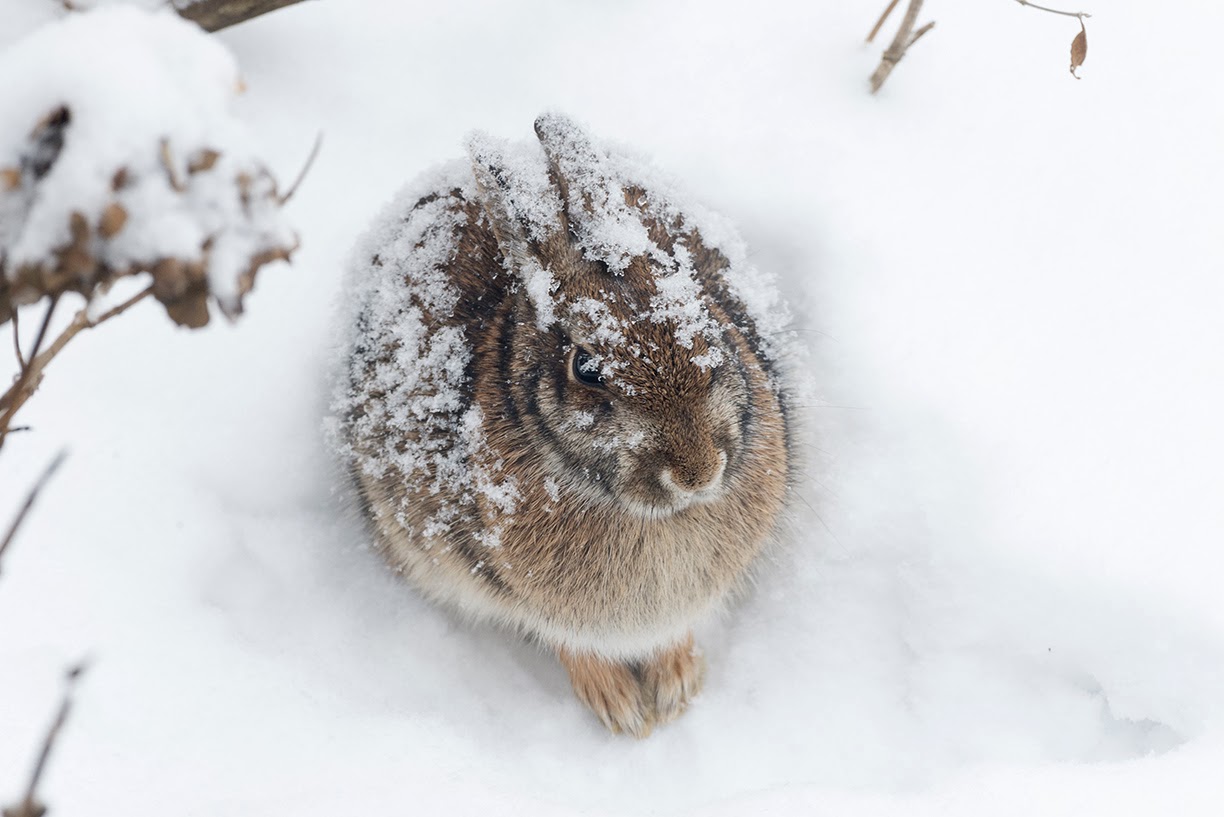
I was gazing out the window, looking under the butterfly bushes at the juncos scrambling for seed when I saw what looked like a piece of a log slowly being covered with snowflakes. But it wasn’t a log at all – it was a rabbit! It was resting in a depression atop last week's snow. Its fur was puffed up like a down blanket, protection against the cold. 

Rabbits do not hibernate in the winter. I have seen several cottontails bounding through my yard all season even when the temperature has been cold enough to keep me inside.

I thought it might like a carrot, given that snow had been covering the ground for the better part of a week and no doubt interfered with the animal’s foraging. I didn’t want to throw it out the window and scare the rabbit away so when I saw it had moved away, I tossed out a nice, juicy organic carrot and hoped it would come back and find the treat. It didn’t – return or eat the carrot.

What I found out was that rabbits change their dietary needs in the cold weather, from vegetables (yes, gardens are a prime venue for these creatures in the spring and summer) to buds, seeds, twigs, branches, and pine needles. We have all of those in our backyard so I guess the rabbit felt welcome but didn’t need the carrot.

BTW Did you ever wonder why rabbits are often called bunnies? Bun is an old English word for “little tail.” More often a baby rabbit is referred to as a bunny, a more endearing term for a small, let’s face it, adorable animal.

But rabbits, cute as they are, are still wild and should be respected as such. We can live together and appreciate each other. All creatures have their place, habits, preferences, and way of life and can be valued for the diversity we all bring to the earth - even as we protect our gardens from the bunnies.

Literally, anything you might ask about rabbits is answered here:

Tuesday, January 7, 2014

Brrr - It's Cold Outside


Brrr - It’s Cold Outside

Wow, the temperature is going crazy lately. Two days ago it snowed where I live. Yesterday started out at 60 degrees, confusing winter with spring. It didn’t stay there, however; the thermometer reading dropped down precipitously throughout the day. By this morning it was 5 degrees, with a wind chill making it feel like minus in the teens. Going out took determination, not to mention a hat, gloves, scarf, sweater, and heavy winter coat.

There is a natural material that is expert at warmth from which many of these products are made - wool. It wicks outside moisture that might chill us away from our body. It also soaks up sweat that we produce to cool us off, a benefit in the hot weather but not good in these kinds of temperatures, and traps it so that we don’t lose valuable body heat. It is also breathable, which makes it adapt to a variety of conditions.

Where does wool come from? Animals. Sheep, alpacas, goats and rabbits are all good sources of wool. It keeps the animals warm in the harshest of weather and it works for us, too. And the good thing is that no animal need be harmed by harvesting the wool. There are grades of wool, too, from the finest to the thickest, each type good for its specific uses.

So, when you are thinking of going outside in these single-digit days, think wool. And also consider layering, a simple technique that helps keep us warm. And enjoy these beautiful days, whatever the temperature.

The definitive word on wool:
http://www.sierratradingpost.com/lp2/wool-guide/

Tuesday, September 17, 2013

Tomatoes - Again?


Tomatoes – Again?

I’m sorry. Here it is, almost at the end of the growing season and I am still talking about tomatoes. I admit to being obsessed with them this year. Perhaps it was the challenge of trying to actually harvest some before the squirrels and rabbits got them all.

Challenges often lead to innovative solutions and this one did. We discovered that surrounding the tomato vine with fine netting seems to keep the critters at bay. I don’t know if they are confused or if the mesh coating covers up the tomato smell; what I do know is that we have had produce ripening on the plant without interference.

I acknowledge that the patch is not pristine looking and I can’t imagine a real farmer doing it but for such a small plot, it has proved to be a reasonable answer to an annoying problem. Each day I eagerly go out to the garden and pick the latest juicy, red treat.

Okay, I confess that I don’t deny the animals everything. After all, they can’t go off to the supermarket when they need food. I leave some of the lower hanging tomatoes out of the mesh for them to share. But at least now we can all enjoy Mother Nature’s bounty. I don’t need to wait until Thanksgiving to be thankful – I feel grateful every time I eat a tomato grown right here at home.

Tips for growing tomatoes:
And now, recipes for those great tomatoes!
http://www.cookinglight.com/food/in-season/fresh-tomato-recipes-00412000076956/page82.html

Monday, July 22, 2013

Tomatoes For All


Tomatoes For All

Hi Everyone. The summer became rather busy so I gave myself permission to take a blog break. I hope you are all well and keeping cool if you are in the heat zone. But I am back and looking things over in my backyard.

We planted a variety of tomatoes this year – cherry, beefsteak, and heirloom varieties. They are all growing nicely, thriving in the heat/rain cycles. Some of them have grown to an incredible size, which thrills me.

I was watching one as it got bigger and started turning a deep shade of red. It was ripening so sweetly. I could imagine how it would taste. The day I went out to pick it, though, I had a shock; a quarter of the tomato was eaten into. I could see the seeds. The juice dripped from the opening and I could smell the fresh tomato aroma. I mourned the loss of such a beauty.

There was another tomato on the vine that was just starting to ripen. I didn’t want the same thing to happen so I placed a cage around that section of the plant.  But when I went to check on it the next day, the cage was lifted out of its moorings and the tomato had been nibbled on.

Was it a wascally wabbit that was getting into the garden or a sneaky squirrel? I was talking to a man who had a vegetable garden and he said that groundhogs, in particular, loved tomatoes. I occasionally saw a groundhog around but not lately.

I needed a plan. While I love letting the tomatoes ripen on the vine, I decided to pick them when they were partially red, before the creatures got into them, and to let them ripen the rest of the way on my kitchen counter. So far that is working. We ate one of our tomatoes yesterday and it was absolutely delicious! I can’t blame the outside critters for digging in.

I know that everyone needs to eat and I don’t mind sharing but I would like some produce for myself, too. Next year I will plan differently, perhaps setting aside a small plot for the local scavengers; this year I will just enjoy what I can and at least take pleasure in knowing that my tomatoes are making a party for many mouths.

Here are some ways to discourage squirrels, and I imagine other critters, from chomping on your tomatoes. Some are practical, others tongue-in-cheek:  http://www.mnn.com/your-home/organic-farming-gardening/stories/7-ways-to-keep-squirrels-from-eating-your-tomatoes    

Monday, October 10, 2011

Hosta Happy


I am hosta happy. At last, a surviving, flowering hosta. This is not a criticism of the popular perrenial; this is a celebration. Of all the hostas we have planted, this is the only one that has made it to the flowering stage. How can that be? you might well ask. These are hardy plants. They tolerate shade, which we have a lot of in our backyard, though a little sun is welcome. Their leaves are their main attraction but they also flower with lily-like blossoms (appropriate as hostas are in the lily family). I see them all over the place. It seems that everyone can grow hostas.

We can, too, which is a fact not lost on the rabbits. They have been munching on our hostas for a few years, now. Each season the hostas send up leaves and as soon as the plants are full the rabbits take over. We see them bounding up to the hostas and suddenly the leaves are gone, whittled down to short, denuded stalks. I heard that fabric softener sheets keep mosquitoes away so I surrounded a couple of the plants with white, flapping sheets – a cocoon of sorts. It seemed to work, for a short while at least, and then it didn’t. I suspect the rabbits were just taking the measure of the sheets and, finding them non-threatening, continued on their hosta fiesta.

I rescued one tiny plant that was left lying on its side, abandoned for some unknowable reason, and stuck it on the back patio in a flowerpot that had lost its previous occupant. Frankly, I did not expect it to live. But then it did. And it flowered! The rabbits did no nibbling. The squirrels left it alone. The chipmunks bypassed it on their urgent scamperings. Good. Let them all ignore it. I pay attention to it because I so appreciate its survival. I may also buy a companion plant next spring and see if I can grow another undisturbed hosta. I love the wildlife in my backyard but I like my garden, too. Surely we can all find a way to co-exist.

Everything you ever wanted to know about hostas from the University of Minnesota Extension Service:http://www.extension.umn.edu/distribution/horticulture/m1241.html