Monday, August 6, 2012

Monarchs - Time to Bulk Up


Monarchs – Time to Bulk Up

I was reading about monarch butterflies. It seems they only like milkweed plants so I was thinking that I might plant some milkweeds for next year. Then I looked out at my butterfly bush, the buddleia, and saw a monarch happily flitting from one flower cluster to another. Hmm.

So I read further. There are four stages to a monarch’s life. Monarchs lay their eggs on milkweed plants. The eggs hatch into larvae or caterpillars, which feed on the plants. They then wrap themselves up in cocoons, where they go into a metamorphosis that turns them into the butterflies. At this point the monarchs can eat from other flowers, including my butterfly bush. Whew. Let them bulk up on my bushes. They will need all the nourishment they can get for their long fall migration.

I found out that each butterfly species has a specific plant that the larvae feed on. And many of those plants, the milkweed included, are being cut down – to build houses, to construct roads, because of wildfires, illegal logging and deforestation of overwintering areas.  On personal properties, they are often viewed as unwanted weeds. This is causing a decrease in the monarch population.

There are reasons to preserve the monarch butterfly (see Conservation points), not the least being that all of nature has a place in this world. I was glad to see the lone monarch on my butterfly bush. I wish it and its companions a successful flight.

About monarchs:
Life cycles and more:
Conservation points:

Monday, July 30, 2012

Good for You, Squirrel!


Good for You, Squirrel!

I was passing my kitchen window early this morning when I saw something that opened my eyes wide. A clever squirrel figured out how to bypass the baffles to the bird feeders. I didn’t see the actual process, just the result. There he/she was, atop the accordion baffle reaching for the seeds. Keeping squirrels off the feeders has been an ongoing struggle. We thought we had finally solved the problem as no squirrel had succeeded in getting past the baffles for a couple of years though there had been several attempts.

My husband was convinced that the squirrel leaped from the branches of the butterfly bush that was nearby. He pruned the bush (it needed it anyway), to make it harder for a squirrel to cross the chasm but I wonder if this particular one will find another way to get up there. I have seen squirrels traverse the whole backyard, leaping from black spruce branches to tulip tree limbs, dashing the length of our back neighbor’s fence, and hurling itself from one maple tree to another, before touching the ground. So perhaps the butterfly bush was the conduit but I suspect that the pruning was only a problem to be solved rather than an insurmountable barrier.

These creatures are certainly persistent. I have to respect that. If the adage “Practice makes perfect” works for people, why not for squirrels? Perseverance is often what leads to success. Writers revise their manuscripts for clarity, inventors discard what doesn’t work and enhance what does, chefs tweak recipes until the flavor is just right. So, I say Good for you, Squirrel! I hope the sunflowers you munched were sufficient reward for your efforts.

You won’t believe this!
Squirrel opening a peanut jar:

And here is an original story I wrote about squirrels in PhlMetropolis:
http://www.phlmetropolis.com/2011/02/outsmarted-by-a-squirrel.php#disqus_thread

Monday, July 23, 2012

Frog or Toad?


Frog or Toad?

I think I saw a frog in my sister’s yard the other day. Or maybe it was a toad. It looked like a rock, snuggled as it was at the edge of the garden.

I know they are both amphibians but it is often hard to tell the difference. I thought frogs always stayed in the water and there is a pond in back of the house but this creature was in the driveway. So was it a toad? But then toads have smaller legs and tend to walk instead of leap and this one scuttled across the cement and then jumped. So was it a frog?

There are many overlaps between them as well as several distinguishing features.  There are differences in the eyes (frogs’ are bulgier) and the legs (toads’ are shorter). Frog skin is usually slimy (toad skin is usually dry) and toads have separate toes (frogs have webbed feet). But reading the literature, it seems that there are common characteristics in some of the areas, skin for instance and habitat. Sometimes it takes studied observation to determine the amphibian’s identity. There is similarity and at the same time individuality.

Which makes me wonder if frogs and toads can cause so much confusion how can we possibly make snap judgments about people? It may take a little time to get to know a person, to understand the person’s habits and intrinsic nature. Who takes leaps and who takes measured steps? Who blends in and who is out there? Pretty interesting, whether in the world of ponds or people.

Frog or toad?
http://allaboutfrogs.org/weird/general/frogtoad.html

Monday, July 9, 2012

Wildlife Habitat


Backyard Wildlife Habitat

The National Wildlife Federation has an interesting program to help our spaces become places in which nature can flourish. They have certified over150,000 Wildlife Habitat sites across the country. A wildlife habitat can be in a backyard, on a roof, in a park – wherever we can put together what is needed to make a nature-friendly environment.  

What does it take to make a site Habitat friendly? NWF says four things:
Food – Water – Cover - Places for wildlife to raise their young.
Every creature needs food. Native plants help the locals thrive. Water is necessary for drinking, bathing, and often for reproduction. Vegetation provides safety from predators and places to raise offspring. 

My backyard has bird feeders, a birdbath, bushes for butterflies, shade and sun, a variety of plants and trees. We did it for our own pleasure; now I see it is more than that. It is not officially certified but it does provide much of what is needed. And even though the rabbits drive me crazy sometimes, I am glad we are providing an area where they can live and be well. Don't we all deserve that?

If you are interested in learning about creating a Certified Wildlife Habitat, you can get started here:

Schools can become part of the green movement, too, by becoming an Eco-School. In my own state of New Jersey there are 36 Eco-Schools, including my township high school.
http://www.nwf.org/Global-Warming/School-Solutions/Eco-Schools-USA/Become-an-Eco-School.aspx

Sunday, July 1, 2012

We Have Potatoes!


We Have Potatoes!

I took some time off from talking about my backyard to just enjoying it. (I hope some of you missed me.) The heat has been oppressive so we have been watering a lot and trying to remember to drink more water ourselves.

Even so, the small vegetable garden we planted was showing signs of distress despite our watering. (Here is where we really show our city roots.) The potatoes, which had sent out such beautiful stems and leaves seemed to have given up. The leaves wilted and the ground looked forlorn. So we decided to dig up the plants, replenish the dirt, and plant something else. We were happily surprised to discover potatoes were under there after all! Not a whole lot and some were not very large but they existed. This was from a couple of potatoes that had sprouted and graced my kitchen windowsill for some time this spring. They were so vibrant that they just called out to be planted.

Everything is a learning experience. We learned that these were our seed potatoes, the potatoes from which the others would sprout. And we found out that it was time to harvest when the stems died back. We did the right things but from intuition rather than knowledge. We’ll know better for next year. Lucky for us, we planted some more seed potatoes (in different spots of our yard) for the sheer joy of them growing. They seem to be flourishing. Can you see me grinning?

This is a great site for the basics:

Monday, June 11, 2012

Summer Squash


Summer Squash

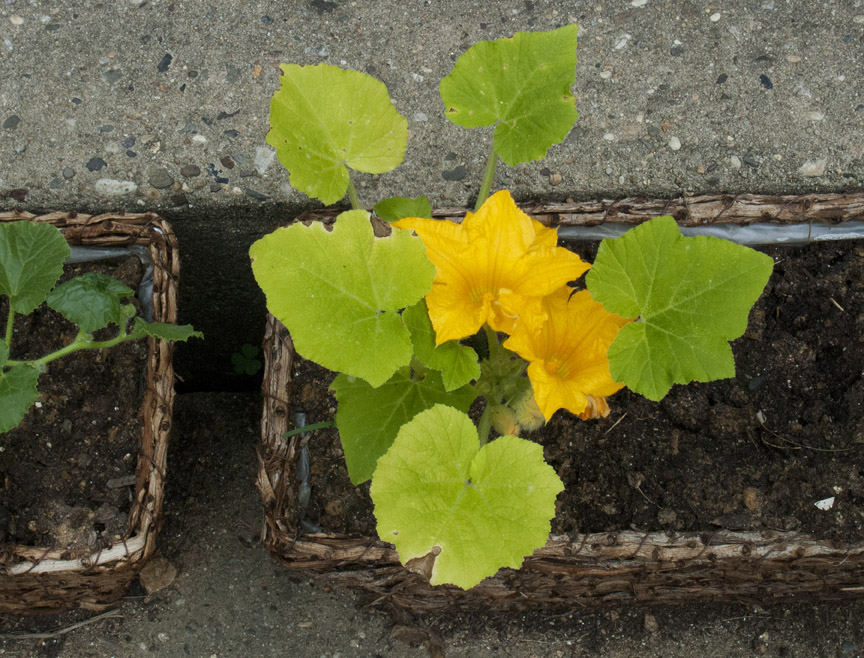
I love this season. It’s exciting to see the vegetable plants starting to sprout. They express themselves so beautifully, even in our makeshift garden. They don’t seem to be bothered that we have so little space for them – only our small side yard has the needed hours of sunlight. So we grow one or two plants wherever we can fit them, starting vines in pots and letting them reach out across the lawn.

On one of our recent trips to the nursery, we were attracted to the squash seedlings. There are so many squash varieties that it is almost impossible not to find one that appeals. They tend to be fast growers, good for those of us who are impatient for home-grown goodness. We put in a couple of Yellow Straightneck plants and now there are flowers bursting into bloom. Underneath we can see the beginnings of the veggies. I understand that it is best to pick them when they are about six-inches, not too large. When the light yellow turns to darker yellow they are over-mature and the plant slows down its production so it pays to be ready when the squash is.

Squash is nutritious and delicious. I am already thinking of recipes – sautéed with chopped scallions, some sliced mushrooms, and a dash of apple cider vinegar perhaps, or maybe sliced lengthwise, brushed with a little extra virgin olive oil, sprinkled with fresh basil (I love basil), and baked, or just plain steamed - all good.

I am enjoying the process, seeing the leaves and flowers unfold, checking on the daily growth of the veggies; whatever we get to eat is a bonus. For me this is dabbling in a mini-farming adventure but it has helped me to appreciate the true farmers of the world.

Extensive info about summer squash:
and do click on the link for Basic Gardening – it will get you off to a great start!

Monday, June 4, 2012

Wasps and People Aren't Compatible


Wasps and People Aren’t Compatible

Okay, so here’s the thing – we have a wasp’s nest tucked into the crook of our garage door where it meets the house. As we enter or leave we have the insects in plain sight and often very close. The nest is getting bigger since we saw it a few days ago. We have to do something.

Wasps are actually beneficial in that they eat a lot of other bugs but they are dangerous so near to people. They will sting if they feel threatened, which is understandable - but not acceptable at a busy threshold. Stings are painful (I know from prior experience), starting with the sharp incision of the stinger. The injected venom stimulates the nerve endings of pain receptors in the skin. Then the body releases a fluid to the site to wash away the venom, which spreads it and causes redness and swelling around the sting area. Not fun. And not something to play around with. Some people are allergic to stings. Anaphylaxis can cause minor irritations such as hives, swelling, nausea, vomiting, abdominal cramps, and headaches. More severe reactions such as shock, dizziness, unconsciousness, or difficulty breathing need immediate attention as they can be life-threatening.

I tend to be reluctant to harm anything in this world; I capture and release spiders found in the house rather than kill them, shoo flies out the window, discourage ants by spreading ground pepper at their points of entry. If this nest were anywhere else I would probably let it be but wasps and people are not compatible so close to each other. It is dangerous here; the nest must go. I hope the next time the local wasps want to build a nest they find a more suitable place.

More than I wanted to know about wasps but helpful, especially regarding wasp management:
A gentler perspective:     
http://www.angelfire.com/ok3/vespids/intro.html