Sunday, July 1, 2012

We Have Potatoes!


We Have Potatoes!

I took some time off from talking about my backyard to just enjoying it. (I hope some of you missed me.) The heat has been oppressive so we have been watering a lot and trying to remember to drink more water ourselves.

Even so, the small vegetable garden we planted was showing signs of distress despite our watering. (Here is where we really show our city roots.) The potatoes, which had sent out such beautiful stems and leaves seemed to have given up. The leaves wilted and the ground looked forlorn. So we decided to dig up the plants, replenish the dirt, and plant something else. We were happily surprised to discover potatoes were under there after all! Not a whole lot and some were not very large but they existed. This was from a couple of potatoes that had sprouted and graced my kitchen windowsill for some time this spring. They were so vibrant that they just called out to be planted.

Everything is a learning experience. We learned that these were our seed potatoes, the potatoes from which the others would sprout. And we found out that it was time to harvest when the stems died back. We did the right things but from intuition rather than knowledge. We’ll know better for next year. Lucky for us, we planted some more seed potatoes (in different spots of our yard) for the sheer joy of them growing. They seem to be flourishing. Can you see me grinning?

This is a great site for the basics:

Monday, June 11, 2012

Summer Squash


Summer Squash

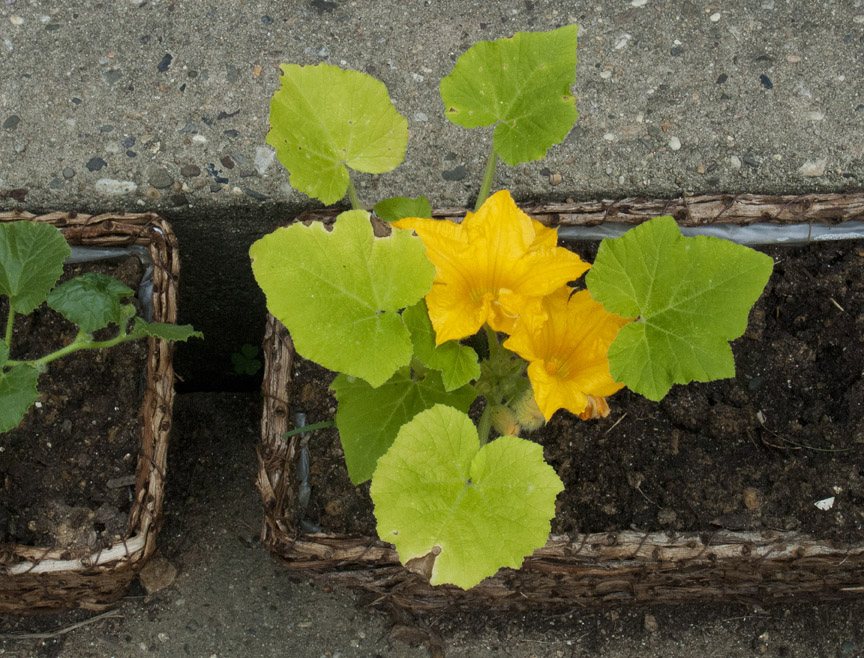
I love this season. It’s exciting to see the vegetable plants starting to sprout. They express themselves so beautifully, even in our makeshift garden. They don’t seem to be bothered that we have so little space for them – only our small side yard has the needed hours of sunlight. So we grow one or two plants wherever we can fit them, starting vines in pots and letting them reach out across the lawn.

On one of our recent trips to the nursery, we were attracted to the squash seedlings. There are so many squash varieties that it is almost impossible not to find one that appeals. They tend to be fast growers, good for those of us who are impatient for home-grown goodness. We put in a couple of Yellow Straightneck plants and now there are flowers bursting into bloom. Underneath we can see the beginnings of the veggies. I understand that it is best to pick them when they are about six-inches, not too large. When the light yellow turns to darker yellow they are over-mature and the plant slows down its production so it pays to be ready when the squash is.

Squash is nutritious and delicious. I am already thinking of recipes – sautéed with chopped scallions, some sliced mushrooms, and a dash of apple cider vinegar perhaps, or maybe sliced lengthwise, brushed with a little extra virgin olive oil, sprinkled with fresh basil (I love basil), and baked, or just plain steamed - all good.

I am enjoying the process, seeing the leaves and flowers unfold, checking on the daily growth of the veggies; whatever we get to eat is a bonus. For me this is dabbling in a mini-farming adventure but it has helped me to appreciate the true farmers of the world.

Extensive info about summer squash:
and do click on the link for Basic Gardening – it will get you off to a great start!

Monday, June 4, 2012

Wasps and People Aren't Compatible


Wasps and People Aren’t Compatible

Okay, so here’s the thing – we have a wasp’s nest tucked into the crook of our garage door where it meets the house. As we enter or leave we have the insects in plain sight and often very close. The nest is getting bigger since we saw it a few days ago. We have to do something.

Wasps are actually beneficial in that they eat a lot of other bugs but they are dangerous so near to people. They will sting if they feel threatened, which is understandable - but not acceptable at a busy threshold. Stings are painful (I know from prior experience), starting with the sharp incision of the stinger. The injected venom stimulates the nerve endings of pain receptors in the skin. Then the body releases a fluid to the site to wash away the venom, which spreads it and causes redness and swelling around the sting area. Not fun. And not something to play around with. Some people are allergic to stings. Anaphylaxis can cause minor irritations such as hives, swelling, nausea, vomiting, abdominal cramps, and headaches. More severe reactions such as shock, dizziness, unconsciousness, or difficulty breathing need immediate attention as they can be life-threatening.

I tend to be reluctant to harm anything in this world; I capture and release spiders found in the house rather than kill them, shoo flies out the window, discourage ants by spreading ground pepper at their points of entry. If this nest were anywhere else I would probably let it be but wasps and people are not compatible so close to each other. It is dangerous here; the nest must go. I hope the next time the local wasps want to build a nest they find a more suitable place.

More than I wanted to know about wasps but helpful, especially regarding wasp management:
A gentler perspective:     
http://www.angelfire.com/ok3/vespids/intro.html

Monday, May 28, 2012

Dappled Willow Hedge


Dappled Willows

The privet hedge on the side of our yard began to have problems. The ground it was planted in is mostly marl, a moist, clay-like dirt. While some of the plants were able to establish good root systems, others had shallow roots and after many years of providing a nice boundary they began leaning, which loosened their root grip even further and negated their hedge-like quality. When their leaves started to wither and their branches turned brittle, it was time to do something.

In browsing the nurseries last year, we came upon the Dappled Willow and immediately fell in love. The white foliage with pinkish tips had an exuberant appeal. We were told that they would only grow to about six feet, though we learned later that this might be a low estimate, and their branching would fill out to form a striking hedge. We amended the soil and planted the first of the hedge line. We waited to see if the willows would survive. They did and when the plants sent out leaves this spring we were entranced with the delicate quality they presented. The sun shined through the translucent leaves so that they seemed to glow. Our neighbor, who has a good view from his deck, commented on their attractiveness.

We planted the rest of the hedge so that now we have a full line of Dappled Willows to admire. We’ll prune them come early winter to encourage dense growth and maintain a reasonable size. Dapple willows are deciduous but the foliage comes out several weeks earlier than most deciduous plants, starting the season with a burst of beauty.

These willows are still young but, like toddlers, they already show their potential. They will fill out and grow and, I imagine, charm us as they do so.

So much to know about Dappled Willows: 
http://www.midwestgardentips.com/hakuro-nishiki_dappled_willow.html 

Monday, May 21, 2012


Tulips Way Above the Ground

We have a Tulip Tree in our backyard. I remember being excited when we got it as a young seedling because we were told it would grow fast. At that time our backyard was just starting to fill out with trees, shrubs, and flowers so we were delighted with the rapid growth idea. Well, several years later and forty feet higher, the Tulip Tree is a mainstay of the yard. And it keeps growing. We learned that it can actually grow to be 150 feet! That’s a little more than we expected.

This past weekend we had a visual of the potential of the Tulip Tree. We went to the opening of Duke Farms in Hillsborough, NJ, http://www.dukefarms.org/en/About-Us/  and in our walk through part of the 2,740-acre property of the Duke family we came upon some Tulip Trees that were three times the thickness of ours and way higher. The Duke Farms is now open to the public. Its mission “is to be a model of environmental stewardship in the 21st century and to inspire visitors to become informed stewards of the land.”

Despite its size potential, I am glad we planted our Tulip Tree. It is a treat to see the tulip-like flowers each spring. It’s like having an outdoor bouquet.  Most of the flowers bloom toward the top of the tree – more sun, I guess – but they eventually drop down to be admired. I learned not to press my face too close, however, as they are a source of pollen, which makes bees happy but can trigger allergic reactions. Our tree is also a harbinger of Fall. Its leaves flutter to the ground earlier than most in a bittersweet reminder of the cycle of seasons.

American Tulip Tree:
http://www.untamedscience.com/biodiversity/plants/flowering-plants/dicotyledons/magnoliales/magnoliaceae/liriodendron/american-tulip-tree

Monday, May 14, 2012

The Ways of Blue Jays…and Others


The Blue Jay family has spotted our feeders. Each day they plop their hefty bodies on one perch or another and munch away. Larger than a robin though smaller than a crow, they have presence. The smaller birds like the finches and sparrows scurry off to settle on our roof until the feeders stop shaking when the jays arrive. Watching from my kitchen window, I am quite taken by these birds.

One morning I took a photo when the Blue Jay was feeding. I could not tell if it was the male or female as they both have the same coloring. I watched for a while until the bird flew off. I put my camera away, prematurely it seems, because when I looked back the Blue Jay was there again and then a male Cardinal with its bright red feathers came along. And then a bright yellow male Goldfinch joined them. There was a bird rainbow right outside my window! I was glued to the sight. I finally ran to get my camera again but they were gone. The Blue Jay returned for another meal later in the day.

The colors and markings of birds are riveting. They add to the sense of the various species. Yet it is more the way they act that defines them. Birds have personalities both as a group and as individuals. Kind of like people. We often identify with groups that have similar interests but act individually within those groups. Blue Jays, for instance, will eat eggs of other birds but they will vigorously defend their own nestlings. People can be adamant about politics but can set aside dogma to help a neighbor in need. I guess we all, birds and humans, show our colors in different ways.

Some general Blue Jay facts:
For you true birders who want to identify Blue Jay calls:
http://www.birdjam.com/birdsong.php?id=5

Monday, May 7, 2012

Lilac Time


Lilac Time

Years ago we planted a lilac shrub in front of our house. It slowly grew each summer and put out lovely pale purple blossoms. Now it is large, full and bushy, with a scent that envelops us as we open our front door. The bush is thriving and expanding; we will need to prune it back – again – after the flowering season.

We also planted a lilac bush in our backyard. It was a different variety with darker flowers and a more delicate scent. It grew tall and leggy and did not do as well. The trees that were growing up at the same time provided too much shade for this sun-loving plant. So we dug it up and replanted it in a sunnier location. For two years it reluctantly put out leaves, no flowers, and half of it stopped growing at all. It looked so fragile, almost pathetic. This year, much to our surprise, it bloomed with such incredible vigor on one side that we staked it and each day look out in wonder at the rejuvenation of this beauty, in awe of its will to live.

Two bushes, very different personalities, same family (Syringa vulgaris).  One had an optimal growth situation, the other was forced to deal with a challenge. Yet they both found a way to express themselves in relation to their circumstances. And we love them both.

That’s the joy of diversity. There’s something to admire in every expression of life.

Lilacs can enhance any garden: