Monday, April 18, 2011

Easter Cactus


My Easter cactus is in bloom. It is a delight to see the bright pink flowers opening up on my windowsill. And it’s right on time, an April bloomer. As usual, I have been somewhat lackadaisical in my stewardship of the plant. Only after it sent out buds did I check it out. I learned it likes a loose, fairly coarse soil with dry feet so it doesn’t get root rot. It is advised that the plant be placed on a dish with pebbles and watered that way. The cactus thrives in indirect sunlight. It appreciates being fertilized once a month between spring and fall. After its growing period it is best to give it a winter rest in a cool place with minimal watering.


Okay, what did I do that was right? Well, not much. There was no pebble-dish for my plant – I watered it when the soil on top felt dry. But its feet were probably dry because the water must have been pretty much absorbed by the time it got down there. I fertilized it when I remembered rather than on a schedule. There was no official rest period for my cactus; it remained on the windowsill all year. It got the right kind of indirect sunlight, however, as my windowsill faces north. How, I wondered, did this poor plant survive no less put out such beautiful flowers?


I remember an experiment I did with a friend. We each potted two plants, put them in the same place, and watered them equally. The only difference was that we nurtured one plant more than the other, talking to it, caressing its leaves, sending it our best wishes. Both of us found the same results, the nurtured plant thrived while the other one just maintained itself. I realize that I have been doing the same kind of nurturing with my Easter cactus, appreciating it even as I didn’t follow the prescribed care. And it thrives.


Maybe rules don’t count as much as intention. Would all people thrive if we offered them basic needs and appreciation? In our contentious world there often isn’t room for nurturing or acceptance of differences. Common wisdom for the Easter cactus wasn’t what helped the plant grow but grow and flower it did. I wish every person, in every culture, in every country be giving the liberty to thrive. It’s a good time of year for us all to blossom.

Monday, April 11, 2011

For Eloise


For Eloise I usually blog about what is going on around me – in my backyard, my neighborhood, places I visit and things I hear about. Today I have to blog closer to home. I may have mentioned my cockatiel Eloise. On April1, she turned twenty-two; on April 10 she passed into birdie heaven.


That is a long life for a cockatiel; most live 12-15 years though I did hear of a bird that lived to be twenty-six. We were aware that she was beginning to show signs of age. She hadn’t been flying as much lately and when she did, she often got lost and had to be rescued. Her food choices changed. She used to love vegetables (she preferred red-leaf lettuce to romaine) and fruits (she would dance back and forth on her perch when watermelon was being served) but she began to ignore anything wet or soft, favoring crunchy things. And she stopped wanting to do her usual things such as roosting on the railing of my chair in the kitchen to share my lunchtime crackers or keeping my husband company on his shoulder (she liked him best) while he read the morning newspaper. I always knew when my husband was about to come home because Eloise would chirp loudly and, sure enough, shortly thereafter he would pull into the driveway. I became aware recently that she stopped chirping at his approach.


We knew she was winding down but she was still pretty perky and interacted with us. Shortly after her birthday Eloise started to seriously decline. She was always free to leave her cage though she began to spend more time inside and when she left tried to fly, she went down to the floor and could not fly back up. My husband or I would gently lift her and she would scramble back on the bars. Eloise had always been a family-conscious bird. Even though I fed her first, she would wait until we were both seated at the table before she would dig into her own dish; suddenly she was eating before us or ignoring her food altogether. Then she started wanting to spend more time with me, a distinct shift from her fixation on my husband. She would let me gently pet her, a previous no-no, and lay her head against neck when I stood beside her cage. Her chirps changed, too. They became weaker and of a different quality, almost like a plea for me to come over and be with her, which I usually did.


On Saturday, Eloise made a sound that made me put aside what I was doing and rush over to her. She instantly stepped off the top of her cage and onto my shoulder. Then she snuggled against my neck and stayed there. It seemed to comfort her. If I moved, she moved – to get even closer. I spent much of the afternoon and all of the evening with her pressed tightly against me. At bedtime, we gently put her in her cage and said goodnight, wondering if she would be there to greet us the next day.


Eloise was down on the bottom of her cage in the morning. She had died in the wee hours by herself. I was feeling sad about her death but also about not being there when she died. But then I remembered that people often wait until they are alone before they depart. We buried her lovingly, already missing her. She had been a long-term companion. I hoped that we gave her as much as she gave us, that she felt loved and cherished during her life.


I am sure that many of ,you have loved animals or birds. Please feel free to share your stories.

Monday, April 4, 2011

Airplane in the Plum Tree


Last fall a neighbor’s preteen son got his toy airplane tangled up in the ornamental flowering plum tree in our front yard. I came outside to see him and three friends on my lawn shouting and throwing sticks and stones into the branches. They succeeded in dislodging lots of leaves and a couple of twigs but the plane remained in place. I didn’t want them to be disappointed but I also didn’t want my poor tree harmed. One of the boys had been vigorously climbing among the branches and the wood was bending. I did some shouting myself, demanding that the boy get down before he got hurt. Although the tree is not a sapling, it is delicate and not used to holding that kind of weight. I assured them that when my husband came home we would get out our ladder and rescue the plane. By early evening we did get the plane down and I returned it. We had been very careful not to damage the toy though I wasn’t so sure about the state of the tree after its ordeal.


Now it’s spring and the tree is beginning to blossom. There are pink buds on all the branches but there are also snapped-off edges to some of the limbs that give evidence to the fall’s trauma. Trees must have hearty souls. The Bradford Pear in the yard next door lost half of itself, a large trunk’s worth, during a storm yet it is sealed off the damage and is flowering. The township cuts large gaps in the trees that grow around utility lines and the trees, even in their truncated state, continue to send out leaves.


I respect trees. Their variety is incredible and their strength inspiring. Trees feed us and shade us and provide beauty of form, color, and perseverance. They even support housing for lots of creatures and when they are harvested, housing for us as well. I guess I needn’t have worried about my little plum tree; it can take look out for itself. But I do hope it knows that I care.

Tuesday, March 29, 2011

The Robins are Back


The robins are back! They are the traditional announcement of spring. A few of them have found my backyard where they gather to munch earthworms underneath the bird feeders. They scratch the ground and pluck the worms up with their beaks, a food they seem to relish though they get most of their diet from bugs and berries. I’m lucky there are only a few: robins because they often roost in great numbers. I remember seeing a stand of trees leading to my father’s apartment complex completely covered with robins.


This robin flew into my peach tree after a hearty lunch and seems to be scoping out the surroundings. I think it’s a male because of its darker red coloring. There is probably a female somewhere nearby; this is breeding season. I will carefully look for a nest, no doubt hidden in the branches of my overgrown forsythia bush. Robins can have two or three successful broods. Their blue eggs are vibrant and beautiful. But I say carefully because robins are known to dive-bomb a snooper to protect the nest.


I like the idea of nature’s yearly repetition - April showers, May flowers, and robins in the spring. There is something comforting in anticipating the cycle, in remembering that even as things change, they are also somewhat predictable. I know that not everyone has the same seasonal signals but they may have robins. These birds are prevalent all over America. Maybe that’s why the bird is called the American Robin.


Monday, March 21, 2011

Daffy for Daffodils


I’m daffy for daffodils. When their leaves peek through the crusty winter soil I am reminded that warmer weather is approaching, that spring is about to kiss the waiting bulbs and early blooming flowers into life, and the earth is renewing itself once more. The tall, spiky deep green leaves that defied snowflakes and sudden cold snaps are fuller and robust now. The buds, elongated hints of anticipated blossoms, tempt me to get out my gardening tools and play in the dirt. And now…voila! The daffodils are open. The corona reaches out like a trumpet to herald spring. There is nothing quite like that golden yellow to perk up the spirit.

Of course, there are other colors to delight us as well. There are even miniature daffys, if you prefer. According to the American Daffodil Society there are between 40 and 200 daffodil species and over 25,000 hybrids! The ADS puts out a lot of information about daffodils on their website http://www.daffodilusa.org/daffodils/faq.html and they also have a journal. I learned that narcissus is the Latin or biological name for daffodils but there is no difference.

But there are many things that excite me about daffodils. The color, yes. The early blooming, certainly. Then there is their persistence. I thought I had raised all the bulbs in my side yard to replant in another location but they are back through bulb division that I didn’t catch and I’m glad; they are so cheerful. And even better, the squirrels (I apologize for talking about them yet again) don’t seem to eat them! We don’t have tulips but we always have daffodils. How great is that?

Here is a picture of my daffodils. Feel free to post photos of your own.

Monday, March 14, 2011

Pick a Pack of Pansies


I’m getting ready. I bought a pack of pansies. It was an impulse purchase at my local supermarket. How could I resist those smiling flowers? They made me forget that I had to run from my car through a chilling rain. They flaunted their colors: pink and purple, a dusky maroon and shy, dawning yellow. I chose purple, a regal color.

Pansies are interesting flowers that come full of meaning. The word pansy is from the French pensee, which means thoughts and remembrance. It is most often associated with loved ones, those currently in your heart and those who have passed away.

They are practical, too. They bloom prolifically from spring until fall, adding vibrant color and fun to a garden. Although they look delicate they are rather hardy and make great borders. Pansies, particularly the yellow and blue variety, have a pleasing perfume-y aroma and both the flowers and petals are edible.

For me they, like the crocuses that just came up in my front yard and the robins who made a brief appearance in my back yard, are harbingers of spring. I am looking forward to the rebirth of my perennials and to planting some new annual guests. They all remind me of the cycle of seasons, the renewal of life. Yes, I’m getting ready. For planting. For spring.


Monday, March 7, 2011

You Lookin’ at Me?

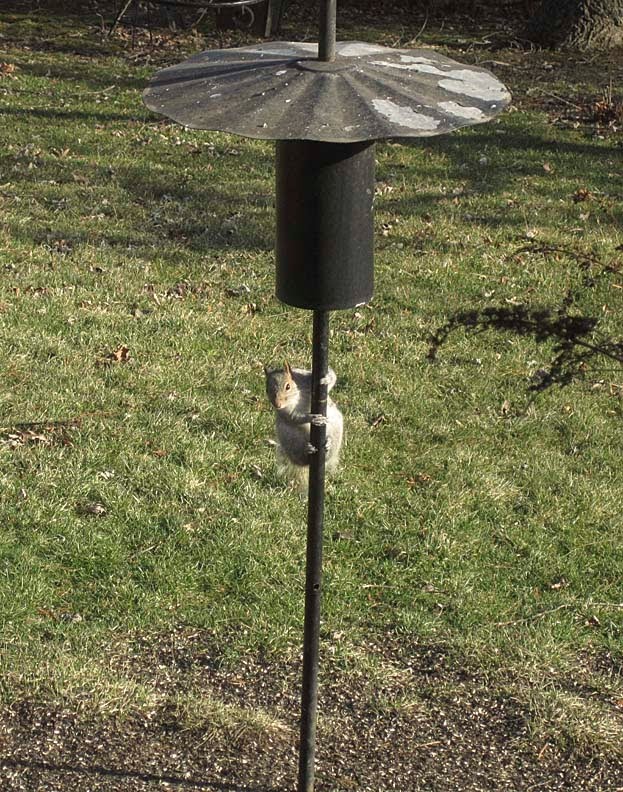
I haven’t written about squirrels in about, oh, four minutes. But they keep coming up with stuff I can’t ignore. This little guy was running up and down the pole beneath the baffle. Sometimes all we could see was his tail hanging out of the tube, sometimes his head would be poking down. He stopped midway with a “You lookin’ at me?” expression that made my husband run for his camera. This wasn’t the fearful “hide from the hawk” kind of action. Nor was it the “how can I get the seed?” dilemma. He was hanging on with attitude. Expressing entitlement. This baffle was his and we had better not challenge that!

Okay, then. We have lived with this kind of furry brazenness for quite a while now and it doesn’t intimidate us. (Hear that Squirrel?) Only it is coming up to spring and I start to browse the garden catalogs with, if not trepidation, a tad bit of nervousness. Squirrels have challenged everything I have planted. As I mentioned before, we have yet to enjoy one single peach from our lovely little tree. Once a squirrel sat munching on a beautifully formed green pepper while he stared me down. These guys don’t seem to like my basil plants but they dig them up anyway. I could almost imagine them snickering (“Heh, heh, this’ll get her!”) before I bolted out the back door yelling at them to leave those pots alone!

This year I am thinking of trying some patio gardening – blueberries, dwarf cherries, tomatoes. Maybe if I see the critters eyeing the goodies I can move the pots to another location to confuse them. (“As if!”) Did someone say something? Anyway, at the risk of my best laid plans going awry, I will be out there with springtime expectations and squirrel awareness. Those cherries look so darn delicious. This year, squirrels, I will have a harvest! (I hope.)

Any thoughts about squirrel-proofing a garden?